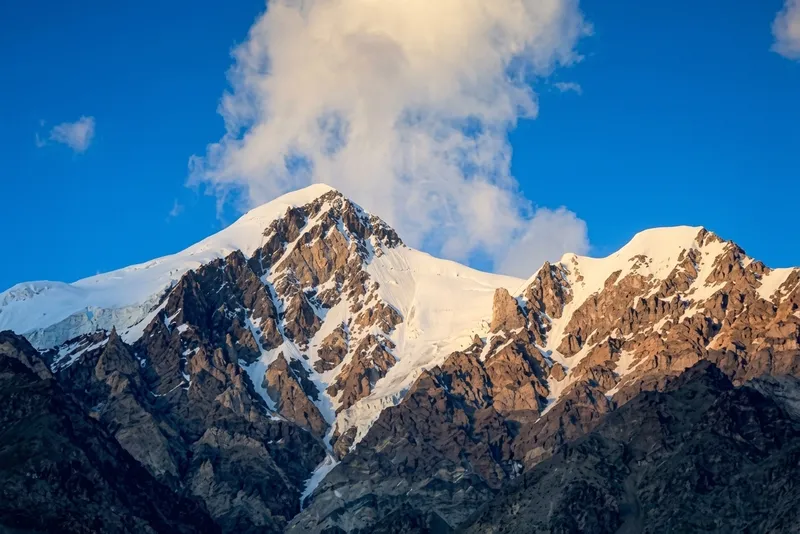
Every year I meet climbers who dream of the Karakoram but worry that its big names are too hard, too technical or too far from their experience. For many of them, Khosar Gang is the answer. At 6,046 m, it is a real 6,000er, with real glacier travel, a real summit day and real altitude, yet it asks for far less technical skill than the famous peaks. If you can walk for many hours, have basic crampon and ice axe skills, and want to know how it feels to stand above 6,000 m, this is a very good place to start.
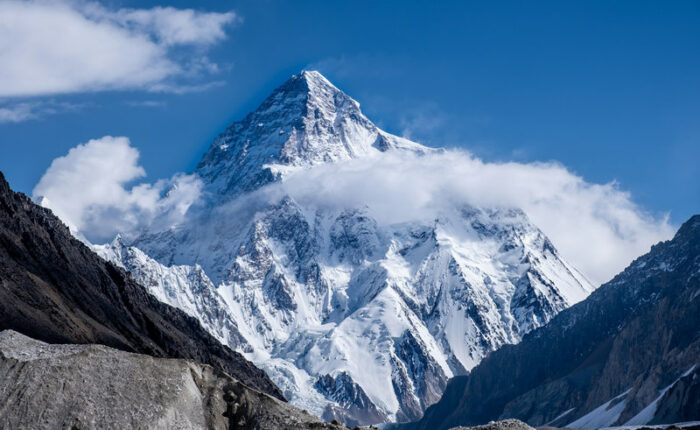
The peak rises above the Sildi area of Shigar Valley, about two hours’ drive from Skardu. We fly from Islamabad to Skardu, spend a day or two preparing, then drive to the road head and walk in to Base Camp at 3,800 m, where local Balti shepherds graze their animals in summer. After a rest day to acclimatise, we climb through Camp 1 (4,800 m) and Camp 2 (5,200 m) and make our summit attempt from there. On a clear day, the view from the top is the reward: K2, Gasherbrum I and II, Broad Peak and Nanga Parbat, with Rakaposhi, Haramosh, Spantik and many other 7,000 m peaks around them.
The 15-day plan includes spare days for weather and flight delays. In the mountains of Pakistan, those spare days are what make the difference between a stressful trip and a successful one.
Best season: July to August (summer departures) Duration: 15 days (arrival to departure from Pakistan) Max altitude: 6,046 m Fitness: Good fitness needed (grade C on the operator’s scale) Technical level: Moderate (grade 3). Basic use of crampons, ice axe and fixed ropes required. Group size: Up to 12 climbers
• Climb a genuine 6,000 m peak in the Karakoram on a trekking-peak style climb, without needing an expedition-level résumé
• Summit views of K2, Gasherbrum I and II, Broad Peak and Nanga Parbat on a clear day
• Views of Rakaposhi, Haramosh, Spantik, Baintha Brakk and other 7,000 m peaks
• Life with Balti shepherds at Base Camp, and a view over the Braldu River valley
• A classic Karakoram flight from Islamabad to Skardu, with views of Nanga Parbat
• Skardu sightseeing: Kharpocho Fort, the old bazaar, and optional trips to Sadpara Lake
• Eagles, vultures and other birds along the route
• The flexibility to rest at Base Camp if you decide not to climb to the top
• Fixed rope on the steepest section and a mountain guide for equipment training and the summit push
Welcome to Pakistan! Our guide meets you at Islamabad International Airport, holding a sign with your name. We transfer you to the hotel, where you can rest after your long flight. In the early evening, we meet for a briefing, a gear check and a dinner together. If you arrive late, the briefing happens in Skardu.
Overnight: Hotel in Islamabad (twin sharing)
We take the early morning flight to Skardu. If the clouds allow, you will see Nanga Parbat rising above the clouds. After checking in, the rest of the day is free to relax and get used to the altitude.
Overnight: Hotel in Skardu
We walk up to Kharpocho Fort for a view of the Indus River and the town below. In the afternoon, you can visit Sadpara Lake or the bazaar to buy last-minute items. While you relax, our team handles the government paperwork. This sometimes takes two days, and our spare days at the end of the trip cover any delays.
Overnight: Hotel in Skardu
We drive for about two hours to Sildi, as far as the jeep track goes. We meet the porters who will carry the loads, and then we walk up to Base Camp. The walk takes several hours on a gradually rising path, with lovely views of the valley. We camp in twin-sharing tents.
Overnight: Camping at Base Camp
A rest day is a working day in the mountains. We sort the gear, practise using crampons and the ice axe, and take a short acclimatisation walk above camp. Drink plenty of water and eat well.
Overnight: Camping at Base Camp
We climb slowly through grassy slopes and then on a stony ridge, in about 4 to 5 hours. This is our first night on the mountain, and it is cold and quiet. We keep a slow pace to help the body adapt.
Overnight: Camp 1
The route continues along an easy ridge to Camp 2, about 3 hours. The camp may still have some snow early in the season, but by August it is usually below the snowline. We set up camp, eat and rest early.
Overnight: Camp 2
These days give us up to three chances at the summit, depending on weather and how everyone feels. We start very early, when the snow is firm. The route follows a gentle ridge, then a steeper section where the guide fixes about 100 m of rope. After that, moderate slopes lead to the top. Plan on 5 to 6 hours up and 3 to 4 hours down. Between Camp 2 and the summit there are crevasses, which we avoid with the rope and local guide knowledge. After the summit we return to Camp 2 to rest.
If you do not feel strong, you are free to stay at camp, and no one will judge you. A good decision on the mountain is a successful decision.
Overnight: Camp 2
We pack up and descend from Camp 2 to Base Camp. You will feel the thicker air with every step. Tonight we celebrate with the team.
Overnight: Camping at Base Camp
An early start for the 3 to 4 hour walk to Sildi, where we have lunch. Then we drive for about two hours back to Skardu, where a hot shower and a real bed wait.
Overnight: Hotel in Skardu
We take the flight to Islamabad and relax at the hotel. If the flight is cancelled by weather, the back-up is a road transfer to Chilas (8 to 10 hours), used only if official advice and road conditions allow.
Overnight: Hotel in Islamabad
This day is reserved for flight cancellations. If everything went smoothly, it is a free day for sightseeing in Islamabad and Rawalpindi, shopping, or a farewell dinner.
Overnight: Hotel in Islamabad
Our team takes you to the airport for your flight home. Hotel check-out is at noon, so please choose a flight time that fits, or ask about an extra night.
Breakfast included
• International flights and your Pakistan visa (we supply the supporting documents)
• Personal travel insurance with high-altitude rescue and helicopter evacuation
• Some lunches and dinners in hotels and restaurants (typically about 5 lunches and 6 dinners), roughly US$4 to $9 per meal
• Bottled water and drinks in towns
• Personal equipment: boots, down jacket, sleeping bag, trekking poles, and so on
• Personal technical gear: crampons, mountaineering boots, ice axe, harness, carabiners and helmet
• Extra hotel nights in Islamabad, extra baggage weight above the porter limit, and baggage storage in Islamabad
• Single room or single tent supplements (available on request for an extra fee)
• Tips for guides, porters and staff
• Laundry, minibar, phone calls and souvenirs
• Costs of an early return from the mountain for any reason
• Costs caused by force majeure, such as earthquakes, landslides and floods